Tools

 This page includes practical tools to help you plan, implement, and reflect on your coaching interactions. Each tool is designed to support consistency, guide meaningful conversations, and document progress as you work with coachees. Together, they provide structure and clarity throughout the coaching process—helping you prepare for sessions, stay focused on identified goals, and capture outcomes and next steps. These resources can be adapted to fit your coaching style and the unique needs of the early intervention professionals you support.
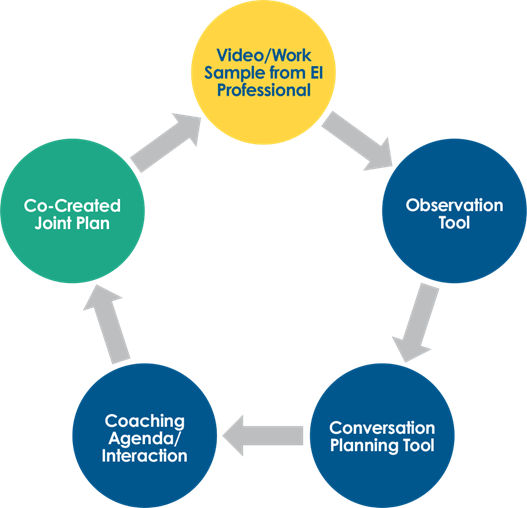
This graphic depicts a cycle that represents the continuous process of effective RBEI coaching. Each step connects to the next—beginning with observation, moving through planning, interaction, and co-created action, and culminating in reflection through shared video or work samples. Together, these interconnected steps illustrate how ongoing collaboration supports professional growth and the consistent use of evidence-based practices in early intervention.
Observation Tool
The EI Practices Observation Tool (Observation Tool) is used by the coach to identify how practices are being implemented by the EI professional during a home visit for the purpose of providing data to inform ongoing coaching conversations. Because the roles of the Services Coordinator (SC) and the EI provider are different, there are two Observation Tools for Getting Ready, one for each professional. The Observation Tool for the RBI is used regardless of the EI role.
The Observation Tool provides an alternate structure to gathering data from professionals as compared to the standard Implementation checklist. The implementation checklist can lead to heavy reliance on feedback when used for data collection. The Observation Tool assists the coach to document observations in a way that first emphasizes strengths, which is more likely to result in the coachee’s goal achievement.
The Observation Tool is filled out while the coach watches a video or a live visit/contact. It is organized using the same components as the RBI and Getting Ready implementation checklists, but instead of scoring only present/absent, it includes detailed behavioral descriptions with scoring parameters designed to indicate section strengths and opportunities. The format includes space for notes collected by the coach to support the item score. The Observation Tool requires the coach be well-versed in RBI and/or Getting Ready practices, and able to determine reliable fidelity scoring across different types of settings.
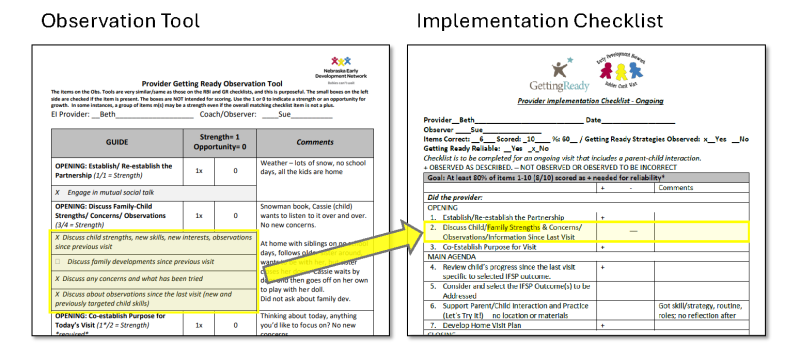
The Observation Tool is also useful during the approval/fidelity process. In the instance where an implementation checklist is “needed to document fidelity”, the present/absent markings (boxes) on the left side of the Observation Tool can be aggregated by section and transferred to the corresponding “items on the implementation checklist.
Observation Tool – Getting Ready, Coaching a Provider
Observation Tool – Getting Ready, Coaching a Services Coordinator
Observation Tool – RBI, Coaching a Provider or Services Coordinator
Conversation Planning Tool
The Conversation Planning Tool is used by a coach to organize observation data in preparation for a coaching conversation. When coaching about EI Practices, because the roles of the Services Coordinator (SC) and the early intervention (EI) provider are different for Getting Ready, the Conversation Planning Tool uses the letters P and SC to indicate items for the respective roles. No letter indicates that the item is used in both professional roles. The Conversation Planning Tool for RBI can be used whether the coachee is a provider or an SC. And finally, the Conversation Planning tool for Coaching Practices/Agenda is used by a coach who is coaching about coaching practices and the coaching agenda. The Conversation Planning Tool provides a roadmap for coaching conversations by guiding the coach to prioritize strengths and opportunities based on the coachee’s observation data, framed by the coachee’s goal and joint action steps.
The Conversation Planning Tool provides a structure to integrate the observations collected by the coach using the Observation Tool. Using the Conversation Planning Tool can increase the probability that the coaching interaction, including the agenda and coaching practices, will be grounded in data and intentional. Developing a plan or intended direction for coaching interactions is based on evidence that successful goal attainment and increased productivity results from intentional planning.
The coach transfers data from the corresponding Observation Tool to the Conversation Planning Tool, filling in circles for items that were present and leaving open those that were not. The coach reviews the data and determines priority strengths and opportunities to be addressed in the coaching conversation. Finally, the coach identifies and plans for the feedback and reflection to be used with the coachee. The Conversation Planning Tool is then ready to be used in the planning for the coaching conversation and/or developing the Coaching Agenda. The coach is not bound to use all pre-planned statements, comments, and/or questions, nor follow a particular sequence. However, the Conversation Planning Tool creates a strength-based and responsive instrument for the coach’s input, ideas, and thoughts.
To supplement the Conversation Planning Tool, the coach can consider including identification of recorded clips that illustrate the coachee’s strengths, as well as segments which lend themselves to reflection on new ideas and learning. Documentation connected to the video or live observation of the coachee (e.g., home visit notes, parent-professional and/or coach-coachee emails/texts) can contribute further evidence of coachee practice implementation.
Conversation Planning Tool – Coaching a Coach
Conversation Planning Tool – Coaching a Provider or Services Coordinator
Agenda
The Coaching Agenda is used by a coach to structure a coaching conversation. It applies across a variety of coaching situations (e.g., ongoing coaching about evidence-based practices, coaching about coaching practices, checking fidelity).
The Coaching Agenda provides a predictable and intentional structure which contributes to familiarity for both the coach and the coachee, increasing the probability of collaborative discussions and resulting in mutually determined goal(s) and joint action steps. While the coachee may not initially be aware of the coaching practices themselves, as the coach interacts with the coachee in a consistent manner, the coachee begins to anticipate how the coaching process works. Time is often limited and the use of the Coaching Agenda helps increase the efficiency of conversations.
The Coaching Agenda is facilitated in 3 parts: Opening, Main Agenda, and Closing, each contributing to the flow of the coaching process. The Coaching Practices (Observation, Reflection, Relationship-Building, Modeling, Goal Setting and Joint Action Planning, Feedback – see resource pages) are used throughout the Coaching Agenda and individualized to each coach/coachee dyad and each coaching interaction.
Opening: The purpose of the Opening is to set the stage for the coaching conversation. The coach establishes/re-establishes the coaching relationship and reviews and facilitates a co-establishment of the agenda items, ensuring a collaborative focus between coach and coachee for identifying the priorities of the coaching conversation
Main Agenda: The purpose of the Main Agenda is to review observations, jointly reflect on progress, and establish future directions. The previously determined coachee goal and joint action plan specifies what the coachee had decided he/she would do between the previous and current coaching conversations; the coach uses this as a point of reference. The coach facilitates review and reflection about the goal and joint action plan, to promote comparison of planned intentions to what happened. Following the coachee’s lead, the coach facilitates a strength- and data-based discussion using the coaching practices to co-develop potential priorities for moving forward. The coach and coachee discuss how the desired skills/behaviors, as indicated on the goal and joint action plan, contribute to a child/family’s IFSP outcomes. The potential priorities generated during the Main Agenda lead into a co-determination of the coachee’s next steps that is specified in the coachee goal and joint action plan.
Closing. The purpose of the Closing is to intentionally wrap up the coaching conversation. The coach summarizes the coaching conversation and the coachee’s goal and joint action plan is reviewed and confirmed. The coach approaches this recap in a collaborative manner, while determining how best to promote the coachee’s confidence and competence. Sharing what each party is feeling good about regarding the coachee’s participation ensures that each coaching conversation concludes in a strength-based fashion.
Note: Coaches are encouraged to share the Coaching Agenda with coachees in advance of coaching conversations in order to solicit coachee input on the agenda and support active collaboration during the coaching conversation.
Agenda – Coaching a Coach
Agenda – Coaching a Provider or Services Coordinator
Goal and Joint Action Plan
The Goal and Joint Action Plan is used during the coaching conversation to co-create a goal and actions that emerge from the coaching conversation. This process typically takes place during the Main Agenda in a coaching conversation. It is applicable for a variety of partners (e.g., Services Coordinators, EI providers, internal coaches), or a group engaged in a coaching process (e.g., ongoing coaching about evidence-based practices during HVs, coaching about coaching practices, checking fidelity). Thus, the topic or content of the Goal and Joint Action Plan will vary and be defined by the focus of coaching (e.g., if coaching a EI provider, the goal and plan might focus on EI use of Getting Ready strategies; if coaching an internal coach, the Goal and Joint Action Plan might focus on how to utilize a coaching agenda or structure).
The Goal and Joint Action Plan is intended to document a mutually determined goal for the coachee, and the steps to be taken by the coach and coachee to advance that goal. The format facilitates a means of professional and joint accountability, respected by both parties because of the collaborative process used to create it. There may be a gap in time between coaching conversations and the Goal and Joint Action Plan helps coach and coachee remember planned actions.
Developing the Goal and Joint Action Plan: There are three parts to the Goal and Joint Action Plan.
In the first section, the questions assist in determining the topic(s) of the goal (“What do I want to focus on?”) and a means of measurement (“How will I know I’ve been successful”). Goals are based on observations of practice and previous goals, and are grounded in the specific coaching content.
To make a plan of action, the tool includes action-oriented questions such as: “How will we do this?”; “What will that look like?”; “When will it happen?” and includes side-by-side sections for both coach and the coachee action steps
Finally, ongoing communication between coaching conversations is identified via the Goal and Joint Action Plan. A space for agreeing on how and when to communicate between coaching contacts is provided along with the timeline for the next coaching conversations
For additional information on goal and action planning, see [link to goal and action plan resource].
Using the Goal and Joint Action Plan During Coaching
The use of the Goal and Joint Action Plan typically begins during the Main Agenda of the Coaching Agenda. After an initial plan has been established, the Main Agenda begins with a review of the previously recorded Goal and Joint Action Plan to guide the discussion of goal status and whether the joint action plan was carried out. This discussion is grounded in data (e.g., plans, reports, observations) from coach and coachee that were specified in the plan as an action step. The Main Agenda discussion ends with determining whether the goal is to be continued or a new goal established, and developing the next joint action plan. Before filling out the Goal and Join Action Plan form, the coach and coachee decide who will summarize the coaching conversation and who will write up the plan. They should also confirm together the resulting Goal and Joint Action Plan.
Goal and Joint Action Plan – Coaching a Coach
Goal and Joint Action Plan – Coaching a Provider or Services Coordinator
Resources and information on this site were developed for the Coaching in Early Intervention (CEI) project with the Nebraska Center for Research on Children, Youth, Families & Schools at the University of Nebraska Lincoln. CEI was funded by the U.S. Department of Education’s Office of Special Education Programs through grant number H326M200017.
